Free Masterclass on AWS Security Specialty Reloaded: Crack the New AWS SCS-C03

Thumb

0 repins 0 comments

Free Masterclass on How to Build an Enterprise Security Program

Thumb

0 repins 0 comments

Agile, DevOps, and Waterfall are three different software development methodologies. Waterfall follows a linear, step-by-step approach where each phase is completed before the next begins, making it suitable for projects with fixed requirements but less flexible to change. Agile emphasizes iterative development, frequent feedback, and adaptability, allowing teams to deliver small, incremental updates quickly. DevOps focuses on collaboration between development and operations teams, automating processes to enable continuous integration, testing, and deployment for faster and more reliable software delivery.

Thumb

0 repins 0 comments

Two Certifications. One Program. Unlimited Career Growth. Kickstart your IT career with InfosecTrain’s

Thumb

0 repins 0 comments

Are you ready to take your career in information systems auditing to the next level? We're thrilled to announce our latest batch of the Certified Information Systems Auditor (CISA) Online Training & Certification Course!

Thumb

0 repins 0 comments

Thumb

0 repins 0 comments

Operational resilience focuses on an organization’s ability to continue delivering critical services during disruptions by building strong systems, processes, and risk controls. Business continuity, on the other hand, deals with creating plans and procedures to restore operations after an incident occurs. While business continuity is reactive—activating recovery steps after a disruption—operational resilience is proactive, aiming to anticipate risks, minimize impact, and keep core services running regardless of the situation. Together, they ensure an organization can withstand, recover, and adapt to both expected and unexpected challenges.

Thumb

0 repins 0 comments

Splunk and ELK Stack are two of the most widely used platforms in SOC environments, but they differ in approach, cost, and scalability. Splunk offers a powerful, enterprise-ready SIEM with advanced analytics, automation, and out-of-the-box integrations—making it ideal for organizations that want speed, reliability, and minimal maintenance. ELK Stack (Elasticsearch, Logstash, Kibana), on the other hand, is open-source and highly customizable, giving SOC teams more flexibility and control at a lower cost. While Splunk excels in ease of use and large-scale performance, ELK is preferred by teams that want full customization and budget-friendly deployments.

Thumb

0 repins 0 comments

Privacy Management Framework Training equips professionals with the skills to design, implement, and manage effective privacy programs that protect sensitive data and support regulatory compliance. This training covers key principles like privacy governance, risk management, data handling practices, and continuous monitoring. As organizations face rising expectations around data protection, mastering a Privacy Management Framework helps enhance security, build trust, and advance career opportunities in privacy and compliance roles.

Thumb

0 repins 0 comments

Thumb

0 repins 0 comments

Perimeter defenses are no longer enough. Zero Trust protects every layer —

Thumb

0 repins 0 comments

CISM vs CISSP is a common comparison for cybersecurity professionals choosing between management-focused and technical-focused career paths. CISM is designed for those who want to lead security programs, manage risk, and build enterprise-level strategies. CISSP, on the other hand, is broader and more technical, covering security engineering, architecture, operations, and more. A comparison table helps you clearly understand differences in exam structure, domains, job roles, difficulty level, and salary potential, so you can pick the certification that aligns best with your career goals.

Thumb

0 repins 0 comments

Understanding the Risk Assessment Process is essential for identifying, analyzing, and managing potential threats to an organization’s assets and operations. It involves evaluating vulnerabilities, determining the likelihood and impact of risks, and implementing measures to mitigate them. A well-structured risk assessment helps organizations prioritize security efforts, comply with regulations, and strengthen overall resilience against cyber threats and operational disruptions.

Thumb

0 repins 0 comments

Free webinar on "AI-Powered Spreadsheet Skills: Get Smarter with Data"

Thumb

0 repins 0 comments

Cybersecurity isn’t just firewalls and passwords — it’s an ecosystem. Every domain plays a role in protecting data, systems, and trust. Here’s what modern cybersecurity mastery really looks like

Thumb

0 repins 0 comments

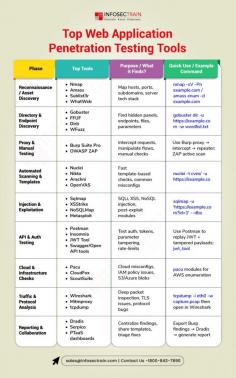
Top web application penetration testing tools help security pros find and exploit vulnerabilities quickly and reliably. Tools like Burp Suite, OWASP ZAP, sqlmap, Nmap, Metasploit, Nikto, and ffuf automate scanning, fuzzing, SQL injection discovery, and reconnaissance while providing manual testing support and powerful workflows for exploitation and verification. Using a mix of these tools—alongside careful manual analysis—lets testers simulate real attacks, prioritize findings, and provide actionable remediation for developers.

Thumb

0 repins 0 comments

Ready to think like an adversary and defend like a pro? Become a

Thumb

0 repins 0 comments

In today’s data-driven world, knowing which standard or framework applies to your business is crucial. Here's a quick comparison to help you navigate the landscape:

Thumb

0 repins 0 comments

IPv4 vs. IPv6 represents the evolution of internet addressing. IPv4 (Internet Protocol version 4) uses a 32-bit address system, allowing around 4.3 billion unique addresses, which are now nearly exhausted due to the rapid growth of internet-connected devices. IPv6 (Internet Protocol version 6), on the other hand, uses a 128-bit address system, providing an almost limitless number of unique IP addresses. Besides expanded address space, IPv6 offers improved security, faster routing, and more efficient network management, making it the future standard for global internet communication.

Thumb

0 repins 0 comments

Free Masterclass For AI-Powered Cloud Security: Tools & Trends in 2026 Date: 04 Nov (Tue) Time: 8 – 10 PM (IST) Speaker: Amit ➡️ Agenda for the Webinar ✅ Exploring the AI • Understanding the AI • Machine Learning vs Deep Learning vs Generative AI • Overview of AI ecosystems: OpenAI, TensorFlow, PyTorch, Hugging Face • Role of AI in cloud-native environments ✅ Cloud ML & AI Ecosystems Overview • Exploring the Machine learning Service in the Cloud • Exploring the AI service in the Cloud • Understanding SageMaker Service and its use case • Understanding Bedrock and it’s Use Cases ➡️ Why Attend This Webinar • Get CPE Certificate • Learn from Industry Experts • FREE Career Guidance & Mentorship Register Now: https://www.infosectrain.com/events/ai-powered-cloud-security-tools-trends-in-2026/

Thumb

0 repins 0 comments

Thumb

0 repins 0 comments

Thumb

0 repins 0 comments

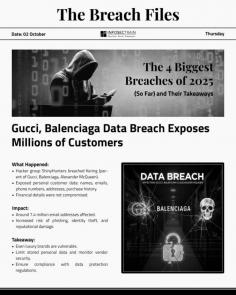
Gucci & Balenciaga have joined the breach list of 2025. Hacker group

Thumb

0 repins 0 comments

AI-generated deepfakes are redefining cyber risk — blurring reality and fueling identity theft, financial fraud, and corporate deception.

Thumb

0 repins 0 comments

The dark web hosts a wide range of hidden resources that are valuable for Open-Source Intelligence (OSINT) investigations. From underground forums, leak sites, and marketplaces to specialized search engines and databases, these resources provide insights into cybercriminal activities, data breaches, and threat actors. Exploring the Top 20 Dark Web Resources for OSINT helps security professionals, researchers, and investigators gather actionable intelligence, strengthen threat detection, and improve overall cybersecurity strategies.

Thumb

0 repins 0 comments

Thumb

0 repins 0 comments

Linux commonly uses ext4, XFS, or Btrfs, which are designed for stability, security, and better handling of large files. These file systems support advanced features like journaling, symbolic links, and case sensitivity. Windows, on the other hand, mainly uses NTFS, which offers good compatibility, built-in encryption, and strong support for permissions but is less flexible than Linux file systems. In general, Linux file systems are preferred for servers and performance-heavy tasks, while NTFS is optimized for desktop use and Windows environments.

Thumb

0 repins 0 comments

ISO standards for information and cybersecurity provide globally recognized frameworks to protect sensitive data and manage cyber risks effectively. Key standards like ISO/IEC 27001 focus on building and maintaining an Information Security Management System (ISMS), while others such as ISO/IEC 27002, 27017, and 27018 offer guidelines for controls, cloud security, and data privacy. By adopting these standards, organizations strengthen their security posture, ensure regulatory compliance, and build trust with customers in today’s evolving threat landscape.

Thumb

0 repins 0 comments

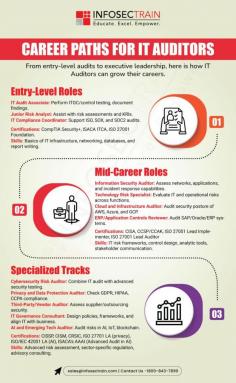
From testing IT controls to leading enterprise-wide risk programs, the IT Audit career path is full of opportunities! ✅ Entry-Level: ITGC testing, compliance support, Security+ & ISO 27001 Foundation ✅ Mid-Career: Risk assessments, cloud audits, ERP reviews, CISA & CCSP ✅ Specialized Tracks: Cybersecurity, Privacy, Vendor, AI & Emerging Tech audits, CISSP & ISO/IEC 42001 Whether you’re just starting or aiming for leadership, IT Audit offers diverse paths to grow your skills, certifications, and impact.

Thumb

0 repins 0 comments

Free Masterclass on ISACA CRISC Old vs New: Latest Updates & Exam Changes

Thumb

0 repins 0 comments

Next Page