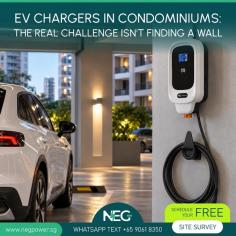
The growing adoption of electric vehicles is changing how residential communities think about parking and energy use. In a condominium, installing an EV charger may initially appear straightforward. A parking bay has a wall nearby, an electrical connection seems available, and the charger can be mounted. However, this approach overlooks the larger infrastructure challenge. In a shared residential development, electricity, parking spaces, distribution boards, cabling routes, and building capacity are collectively connected. When several residents want to charge their vehicles, a simple installation can quickly become an infrastructure planning exercise.

This is why involving an experienced EV Charger Installer Singapore can be important from the beginning. The objective is not merely to install one charger, but to create a charging arrangement that can accommodate present requirements while allowing the condominium to respond to increasing EV demand.

Shared Electrical Infrastructure Changes the Equation

A condominium typically operates with electrical infrastructure designed around the building’s existing demand. Residential units, lifts, lighting, pumps, ventilation, security systems, common facilities, and other equipment all draw power. Adding EV charging introduces a substantial new load that can occur during predictable periods, particularly when residents return home and plug in their vehicles.

Installing a charger without assessing available capacity can create unnecessary strain on the electrical system. A qualified EV Charger Installer Singapore can evaluate the existing distribution arrangement, determine where charging loads can be accommodated, and identify whether additional electrical infrastructure may eventually be required.

The important question is therefore not simply, “Where can the charger be mounted?” It is, “How much charging demand can the building safely support?”

Parking Allocation Can Become Complicated

Condominium parking is another major consideration. A charger permanently installed beside a particular parking bay may effectively make that space an EV charging bay. Yet parking arrangements can involve allocated spaces, shared lots, visitor parking, management rules, and changing ownership or tenancy.

A practical charging strategy needs to consider who can use each charging point and how access will be managed. If only one resident receives a dedicated charger, other EV owners may eventually request similar arrangements. Without a clear framework, the condominium could end up with different chargers, inconsistent installations, and inefficient use of limited parking infrastructure.

An experienced EV Charger Installer Singapore can help property managers evaluate charger locations, cable routes, equipment requirements, and future expansion considerations before individual installations become difficult to coordinate.

Multiple EVs Create a Different Demand Profile

One EV charger may not significantly change a building’s overall electricity requirements. Ten, twenty, or fifty chargers can be a different matter. If many residents plug in simultaneously, the combined load can become substantial.

This is where load management becomes valuable. Instead of allowing every charger to operate at maximum power at the same time, a coordinated system can distribute available capacity among connected vehicles. Charging rates can be adjusted according to building demand and available electrical capacity.

For condominiums expecting growing EV ownership, an EV Charger Installer Singapore should therefore consider charging management as part of the overall installation rather than treating each charger as an isolated appliance.

Planning for Scalability

A common mistake is designing infrastructure only around today’s requirements. A condominium may currently have three EV owners, but that number can change considerably over the lifetime of the charging system.

Scalability means planning cable pathways, distribution capacity, communication systems, charger locations, and electrical equipment with future expansion in mind. The initial installation does not necessarily need to include chargers for every parking space. Instead, the supporting infrastructure can be designed so additional charging points can be introduced more efficiently later.

This approach can reduce repeated construction work and avoid unnecessary disruption to residents. An EV Charger Installer Singapore with experience in multi-user environments can assess how the initial deployment can support future charging demand without requiring the entire system to be redesigned.

Become a Medium member
Load Balancing Supports Efficient Charging

Load balancing is particularly useful where electrical capacity is limited. A smart charging system can monitor available capacity and adjust individual charging rates accordingly.

For example, if the building’s electricity demand increases because common facilities and residential loads are operating heavily, charging power can be temporarily reduced. When overall demand falls, charging can increase again. The vehicle continues charging while the building’s available electrical capacity is managed more effectively.

This approach can also help property managers avoid designing every charging point around maximum simultaneous output. An EV Charger Installer Singapore can assess whether dynamic load management is appropriate based on the building’s electrical configuration and expected charging requirements.

Cable Routing Is More Important Than It Looks

In a condominium, the physical route between the electrical supply and parking spaces can be one of the most challenging parts of an EV charging project. Parking areas may span multiple floors or sections, while electrical rooms may be located far from the intended charging bays.

Cabling may need to pass through ceilings, service areas, risers, corridors, or designated conduits. The installation must account for protection, accessibility, maintenance, and future expansion.

Good planning should therefore happen before equipment is purchased. An EV Charger Installer Singapore can assess possible routes and determine how the charging network can be installed while minimizing unnecessary structural or aesthetic disruption.

Management Policies Need to Accompany Hardware

Technology alone cannot solve condominium charging challenges. Property management and residents also need clear policies covering charger access, payment, maintenance, parking usage, installation approvals, electricity billing, and responsibility for equipment.

A shared charging system may require user authentication and billing so that each resident pays for their own electricity consumption. A dedicated charger may require a different arrangement. The important point is that these operational questions should be addressed alongside technical planning.

An EV Charger Installer Singapore can contribute technical input, but building management should establish the operational framework governing how residents use the charging infrastructure.

Choosing the Right Charging Approach

Not every condominium needs the same charging configuration. Some communities may benefit from dedicated AC chargers, while others may require shared charging stations with multiple users. The appropriate solution depends on parking arrangements, expected charging frequency, electrical capacity, and available installation space.

Charging speed should also be considered carefully. Faster charging is not automatically necessary for residential environments, where vehicles may remain parked for several hours overnight. A slower charging solution can often provide sufficient energy during longer parking periods while placing less instantaneous demand on shared infrastructure.

Building a Long-Term Charging Strategy

The strongest condominium charging plans begin with an assessment rather than an immediate equipment purchase. Electrical capacity, parking allocation, current EV ownership, expected demand, cable routes, management policies, billing, and future expansion should all be considered together.

Working with an EV Charger Installer Singapore early in the planning process can help stakeholders understand the practical requirements before installation begins. The goal is to create infrastructure that works today without making tomorrow’s expansion unnecessarily expensive or disruptive.

Ultimately, the real challenge of condominium EV charging is not finding a wall. It is coordinating electricity, parking, technology, residents, and future demand within a shared environment. A charger may occupy only a small section of a parking area, but the infrastructure supporting it can extend throughout the building.

With thoughtful planning, condominiums can move beyond one-off charger installations and develop scalable charging networks. By assessing capacity, managing simultaneous demand, planning cable routes, establishing fair access, and preparing for future EV adoption, residential communities can create charging systems that remain practical as demand grows. The right EV Charger Installer Singapore can help turn that broader strategy into a safe, organized, and expandable charging infrastructure that serves both current residents and future EV owners.

Pop over here : https://www.negpower.sg/

The growing adoption of electric vehicles is changing how residential communities think about parking and energy use. In a condominium, installing an EV charger may initially appear straightforward. A parking bay has a wall nearby, an electrical connection seems available, and the charger can be mounted. However, this approach overlooks the larger infrastructure challenge. In a shared residential development, electricity, parking spaces, distribution boards, cabling routes, and building capacity are collectively connected. When several residents want to charge their vehicles, a simple installation can quickly become an infrastructure planning exercise.

This is why involving an experienced EV Charger Installer Singapore can be important from the beginning. The objective is not merely to install one charger, but to create a charging arrangement that can accommodate present requirements while allowing the condominium to respond to increasing EV demand.

Shared Electrical Infrastructure Changes the Equation

A condominium typically operates with electrical infrastructure designed around the building’s existing demand. Residential units, lifts, lighting, pumps, ventilation, security systems, common facilities, and other equipment all draw power. Adding EV charging introduces a substantial new load that can occur during predictable periods, particularly when residents return home and plug in their vehicles.

Installing a charger without assessing available capacity can create unnecessary strain on the electrical system. A qualified EV Charger Installer Singapore can evaluate the existing distribution arrangement, determine where charging loads can be accommodated, and identify whether additional electrical infrastructure may eventually be required.

The important question is therefore not simply, “Where can the charger be mounted?” It is, “How much charging demand can the building safely support?”

Parking Allocation Can Become Complicated

Condominium parking is another major consideration. A charger permanently installed beside a particular parking bay may effectively make that space an EV charging bay. Yet parking arrangements can involve allocated spaces, shared lots, visitor parking, management rules, and changing ownership or tenancy.

A practical charging strategy needs to consider who can use each charging point and how access will be managed. If only one resident receives a dedicated charger, other EV owners may eventually request similar arrangements. Without a clear framework, the condominium could end up with different chargers, inconsistent installations, and inefficient use of limited parking infrastructure.

An experienced EV Charger Installer Singapore can help property managers evaluate charger locations, cable routes, equipment requirements, and future expansion considerations before individual installations become difficult to coordinate.

Multiple EVs Create a Different Demand Profile

One EV charger may not significantly change a building’s overall electricity requirements. Ten, twenty, or fifty chargers can be a different matter. If many residents plug in simultaneously, the combined load can become substantial.

This is where load management becomes valuable. Instead of allowing every charger to operate at maximum power at the same time, a coordinated system can distribute available capacity among connected vehicles. Charging rates can be adjusted according to building demand and available electrical capacity.

For condominiums expecting growing EV ownership, an EV Charger Installer Singapore should therefore consider charging management as part of the overall installation rather than treating each charger as an isolated appliance.

Planning for Scalability

A common mistake is designing infrastructure only around today’s requirements. A condominium may currently have three EV owners, but that number can change considerably over the lifetime of the charging system.

Scalability means planning cable pathways, distribution capacity, communication systems, charger locations, and electrical equipment with future expansion in mind. The initial installation does not necessarily need to include chargers for every parking space. Instead, the supporting infrastructure can be designed so additional charging points can be introduced more efficiently later.

This approach can reduce repeated construction work and avoid unnecessary disruption to residents. An EV Charger Installer Singapore with experience in multi-user environments can assess how the initial deployment can support future charging demand without requiring the entire system to be redesigned.

Become a Medium member
Load Balancing Supports Efficient Charging

Load balancing is particularly useful where electrical capacity is limited. A smart charging system can monitor available capacity and adjust individual charging rates accordingly.

For example, if the building’s electricity demand increases because common facilities and residential loads are operating heavily, charging power can be temporarily reduced. When overall demand falls, charging can increase again. The vehicle continues charging while the building’s available electrical capacity is managed more effectively.

This approach can also help property managers avoid designing every charging point around maximum simultaneous output. An EV Charger Installer Singapore can assess whether dynamic load management is appropriate based on the building’s electrical configuration and expected charging requirements.

Cable Routing Is More Important Than It Looks

In a condominium, the physical route between the electrical supply and parking spaces can be one of the most challenging parts of an EV charging project. Parking areas may span multiple floors or sections, while electrical rooms may be located far from the intended charging bays.

Cabling may need to pass through ceilings, service areas, risers, corridors, or designated conduits. The installation must account for protection, accessibility, maintenance, and future expansion.

Good planning should therefore happen before equipment is purchased. An EV Charger Installer Singapore can assess possible routes and determine how the charging network can be installed while minimizing unnecessary structural or aesthetic disruption.

Management Policies Need to Accompany Hardware

Technology alone cannot solve condominium charging challenges. Property management and residents also need clear policies covering charger access, payment, maintenance, parking usage, installation approvals, electricity billing, and responsibility for equipment.

A shared charging system may require user authentication and billing so that each resident pays for their own electricity consumption. A dedicated charger may require a different arrangement. The important point is that these operational questions should be addressed alongside technical planning.

An EV Charger Installer Singapore can contribute technical input, but building management should establish the operational framework governing how residents use the charging infrastructure.

Choosing the Right Charging Approach

Not every condominium needs the same charging configuration. Some communities may benefit from dedicated AC chargers, while others may require shared charging stations with multiple users. The appropriate solution depends on parking arrangements, expected charging frequency, electrical capacity, and available installation space.

Charging speed should also be considered carefully. Faster charging is not automatically necessary for residential environments, where vehicles may remain parked for several hours overnight. A slower charging solution can often provide sufficient energy during longer parking periods while placing less instantaneous demand on shared infrastructure.

Building a Long-Term Charging Strategy

The strongest condominium charging plans begin with an assessment rather than an immediate equipment purchase. Electrical capacity, parking allocation, current EV ownership, expected demand, cable routes, management policies, billing, and future expansion should all be considered together.

Working with an EV Charger Installer Singapore early in the planning process can help stakeholders understand the practical requirements before installation begins. The goal is to create infrastructure that works today without making tomorrow’s expansion unnecessarily expensive or disruptive.

Ultimately, the real challenge of condominium EV charging is not finding a wall. It is coordinating electricity, parking, technology, residents, and future demand within a shared environment. A charger may occupy only a small section of a parking area, but the infrastructure supporting it can extend throughout the building.

With thoughtful planning, condominiums can move beyond one-off charger installations and develop scalable charging networks. By assessing capacity, managing simultaneous demand, planning cable routes, establishing fair access, and preparing for future EV adoption, residential communities can create charging systems that remain practical as demand grows. The right EV Charger Installer Singapore can help turn that broader strategy into a safe, organized, and expandable charging infrastructure that serves both current residents and future EV owners.

Pop over here : https://www.negpower.sg/

Scroll to Top